Why knowing the exact leak rate matters before any pool repair
When a swimming pool loses water, the first instinct is often to call a repair service and describe the problem in broad terms: "The pool is losing water fast." But "fast" means different things to different people. A few inches a week might alarm one owner and seem normal to another. Before any repair work begins, the single most useful piece of information is a precise, measured leak rate. Without it, a repair crew is working blind, and the homeowner risks paying for work that may not address the real issue.
What a leak rate actually tells you
A leak rate is simply the volume of water a pool loses over a set period, usually expressed in inches per day or gallons per hour. But the number itself is not the whole story. The value of a precise measurement lies in what it reveals about the nature and location of the problem. A pool that loses half an inch overnight but holds steady during the day points toward a different set of suspects than a pool that loses water steadily around the clock. The pattern, not just the total, guides the diagnosis.
Measuring the rate correctly requires more than looking at the water level. Evaporation, splash-out from swimmers, and backwashing the filter all remove water without any leak being present. A proper test accounts for these factors, usually by performing a bucket test or using a calibrated gauge over a period when the pool is undisturbed. The result is a baseline that separates normal water loss from a true leak.
How a precise rate changes the repair approach
Once the rate is known, a technician can match the symptom to the likely cause. A slow, steady loss of a quarter-inch per day often points to a small crack in the pool structure or a pinhole in the plumbing. A sudden loss of several inches in a few hours suggests a major rupture in an underground pipe or a failed fitting. The repair method for each is completely different. Chasing a slow seep by digging up a deck is wasteful; ignoring a fast leak while waiting for a scheduled appointment can lead to structural damage or a costly slab collapse.
The rate also helps prioritize which parts of the system to check first. A leak that appears only when the pump runs points to the pressure side of the plumbing. A leak that continues with the pump off suggests a problem in the shell, the main drain line, or the skimmer. Knowing the rate narrows the search, saving time and avoiding unnecessary excavation.
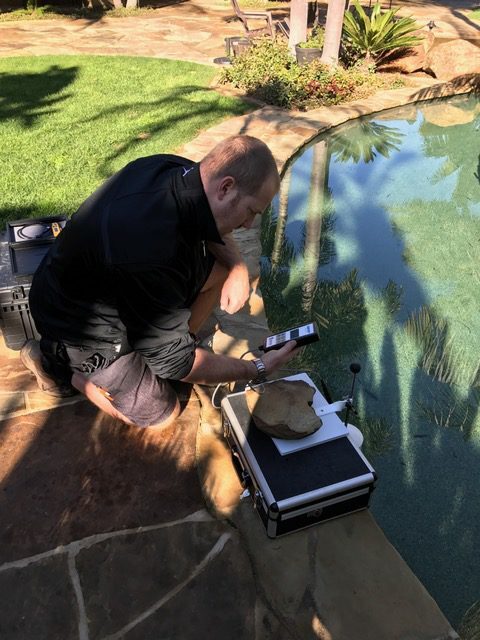
The tools that measure water loss accurately
Modern leak analyzers and pressure-testing equipment can measure flow rates with precision that a bucket test cannot match. These tools inject air or a tracer gas into the plumbing and detect the pressure drop, or they use electronic listening devices to locate the sound of water escaping underground. The data they produce is not just a number; it is a profile of how the pool behaves under different conditions. A water loss rate that changes with temperature or pump speed tells a story that a single reading cannot.
Professional-grade testing equipment also distinguishes between leaks in the pool structure and leaks in the underground plumbing. A structural crack may weep water at a constant rate regardless of pump operation, while a pipe leak often accelerates when the pump runs. The distinction matters because repairing a shell crack involves draining the pool and applying a sealant, while a pipe leak may require digging and replacing a section of line. Starting the wrong repair wastes money and can cause more damage.
Why guessing the rate leads to guesswork repairs
Many pool owners assume that any water loss means a leak in the main drain or the return lines. But a surprising number of apparent leaks turn out to be evaporation, a faulty auto-fill valve, or a leak in the skimmer throat that only shows up when the water level drops below the skimmer mouth. A precise rate, combined with a bucket test, quickly eliminates these false leads. Without it, a repair crew might pressure-test every line, drain the pool, and still find nothing wrong.
Even when a leak is real, the rate influences the urgency. A pool losing a gallon a day may be safe to operate for weeks while parts are ordered. A pool losing ten gallons an hour needs immediate attention to prevent undermining the deck or the foundation of nearby structures. A contractor who arrives without knowing the rate cannot give an honest repair estimate or a realistic timeline.
How the rate connects to the inspection scope
A thorough leak investigation does not stop at the water level. The inspection scope includes checking all access points: skimmers, return fittings, light niches, tile grout, and the bond beam. Each of these can leak at a different rate, and the overall loss is the sum of small contributions. A precise measurement tells the technician whether the total loss is large enough to warrant a full inspection or small enough to target a single suspect area.
For example, a pool that loses one inch per week might have a tiny crack in the plaster that weeps only when the water is warm. A full structural inspection would be overkill. Instead, a dye test around the fittings and a pressure test on the main drain line might reveal the source quickly. On the other hand, a pool losing three inches per day likely has a broken pipe or a failed main drain seal. That calls for a different set of tools and a more invasive search.

What the rate means for the repair estimate
A repair estimate based on a guess is unreliable. A contractor who does not know the leak rate may quote a high price for a full inspection and repair package, or a low price that covers only the most obvious fix. Either way, the homeowner ends up paying for work that may not match the problem. When the rate is measured first, the estimate can be specific: fix the skimmer gasket, seal the crack in the return line, or replace the section of underground pipe. The scope is clear, and the price reflects the actual work.
Precision also prevents repeat repairs. A leak that is partially fixed but not fully resolved will continue to lose water, and the second repair often costs more because the first attempt may have disturbed the surrounding area. A technician who starts with a precise rate knows when the repair is complete because the post-repair test should show zero loss. Without that baseline, there is no way to confirm success.
That is where professional pool leak testing becomes essential. A service that measures the rate before any work begins provides a clear starting point and a measurable goal. The test itself is non-invasive and takes a fraction of the time that a blind repair would consume. It also gives the homeowner confidence that the quoted work matches the actual problem, not a symptom.
When the rate reveals something unexpected
Sometimes a precise measurement shows that the pool is not leaking at all. A persistent drop in water level can be caused by a failing auto-fill valve that overfills the pool during the night, or by a crack in the skimmer throat that lets water escape only when the pump is off. In those cases, the repair is simple and inexpensive, but only if the rate is measured correctly from the start. A homeowner who skips the measurement might authorize a full plumbing replacement for a problem that does not exist.
Other times, the rate points to a leak that is not in the pool at all. A spa that shares a circulation system with the pool can lose water through a valve that fails to seal properly. The pool level drops, but the leak is in the spa plumbing. A precise rate, combined with a valve isolation test, identifies the true source without draining both bodies of water.
The practical takeaway for pool owners
Before any repair begins, the single most important step is to establish the exact leak rate. This does not require special tools for the homeowner; a simple bucket test over 24 hours with the pump running and the pump off gives a useful estimate. But for a reliable answer, especially when the loss is small or intermittent, professional pool leak testing provides the accuracy needed to plan the repair. The cost of the test is small compared to the cost of a misdiagnosed repair or a second visit.
A pool is a system of interconnected parts. Water can escape through a hundred small gaps or one large break. The rate tells the technician which scenario is likely, and that information shapes every decision that follows. Without it, the repair is a gamble. With it, the job has a clear target and a clear finish line.